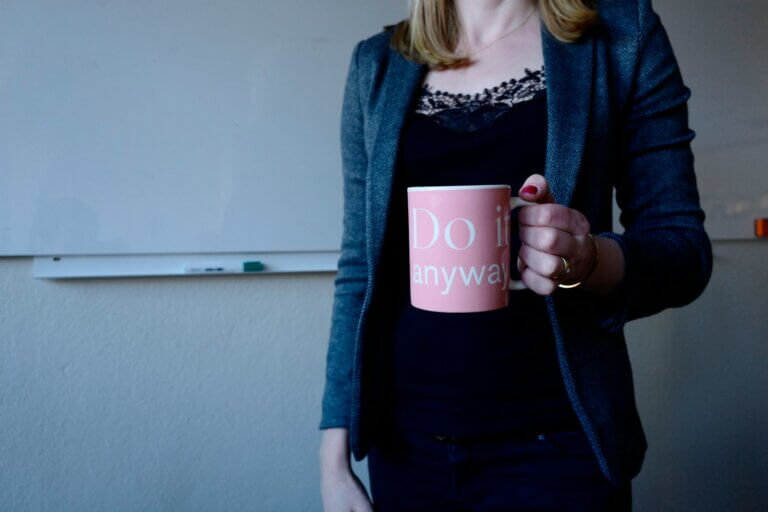
“I have no choice, it’s the process. I don’t see how I can avoid it, even if I don’t approve.”
MC, the director, looks me straight in the eye. She’s looking for my approval. What she doesn’t tell me explicitly is that she has laid down her arms in the face of “the System”. She’s settled into this resignation, this gray area where we end up slowly extinguishing ourselves, thinking that’s the price we have to pay to succeed.
In truth, and she doesn’t know it yet, MC has come looking for a new leadership posture to get out of this thing.
1. The invisible trap: the separation that weakens you
In the HR Business world to which I belong, two worlds often coexist without talking to each other:
-
On the one hand, OD (Organisational Development) – The Framework: structures, processes, talent management. Here, the focus is purely organizational.
-
On the other, People Development: leadership and skills development, coaching. Here, the focus is on the individual.
Each domain works in its own silo. This separation, practical in theory, is a costly solution. Because dysfunctional systems inevitably produce dysfunctional behavior.
If you see yourself separated from the system, you have only two options: suffer or fight. Exhaustion is guaranteed. As long as you stay within this binary logic (it’s the organization’s fault OR it’s my fault), you’re depriving yourself of your power. You forget that the system isn’t a fixed machine, it’s a sum of relationships, of which you are one of the main nodes.
2. The exteriority syndrome
In executive coaching with clients (yes, I have good coaching guys too 😉 ), their stories almost always start with what the organization puts them through: the impossibility of recruiting at the right skill level despite the complexity, the walls between departments that prevent co-creation, the regular interference of big bosses and chiefs in operations, when decisions on key elements are expected…
To be right or to have an impact?
It’s a reality: work has become brutally demanding. And pointing the finger at governance flaws allows us to maintain a salutary distance: “It’s not my fault, it’s the system.” To a certain extent, that’s true.
But it’s also a trap. As Adam Grant points out in Think Againwe often fall into two sterile modes that reassure us but block us:
-
Prosecutor mode: to prove the system wrong.
-
Preacher mode: to convince people that our vision is the only right one.
As soon as we confuse “being right about the system’s diagnosis” with “being effective in our own role”, we stop thinking. We defend a position of lucid victimhood, instead of questioning our starting hypothesis: what if I did, in spite of everything, have room for manoeuvre?
I then ask THE awakening question:
“And you, how do you live it, how do you survive in this context?”
At that moment, the gaze changes. MC’s wiring shifts inward. His shoulders straighten.
You can’t talk about an organization without talking about the people who run it. That’s where leadership begins: when you accept that you’re part of the system’s puzzle, not beside it.
Because if you’re in the system, you have the right (and the duty) to inject new proposals. This is the moment when you stop being a quasi-victim observer, and become a contributor worthy of your role. But for this proposal to be heard, you need a solid foundation. That’s where the “AND” comes in.
3. The posture of the ET: the strength to inhabit one’s place
I discovered “AND” during my NLP Master Practitioner training, a long time ago. On paper, it looked attractive, a magnificent intellectual exercise. I must confess that, at the time, I was very much in my own head… I thought it was enough to understand the concept for everything to change.
But the field taught me something else: ET isn’t just an idea, it’s a posture. A general attitude. It’s the physical ability to stay grounded when two contradictory truths coexist; that moment when you leave mental reflection behind and feel your two feet flat on the ground, standing firm on your legs, back straight, head too.
Strong Back, Soft Front!
This is what Brené Brown calls the Strong Back, Soft Front a strong back to hold the frame, and an open heart to stay connected. Becoming an actor means refusing to choose between “bending to the process” or “resigning internally”. It’s deciding to inhabit both:
-
The Designer: You look at the framework coldly and dare to propose new rules of the game. You don’t ask for permission, you make a value proposition.
-
La Coach : You stay in touch with people, you listen to what they don’t say, you reinject trust where there’s only procedure.
The bridge: from your sovereignty to yours
But be careful: this new posture must not remain a solitary exercise. If you change on your own, you’ll create a gap. Your sovereignty only makes sense if it becomes contagious.
Becoming an actress isn’t about carrying the world on your shoulders, it’s about opening a door so that others can stop suffering too. This is where your individual leadership is transformed into collective power. For your team to move from “we undergo” to “we act”, you need to create the container capable of receiving this new energy.
4. Creating space: the “AND” in action
Your feeling of powerlessness is a symptom of collective asphyxia. We’re running out of time, so we stop thinking. As Otto Scharmer teaches in Theory Utransformation emerges from the quality of the space from which you act.
Before you rush off to “fix” a meeting or a project, give yourself (and your team) a moment of silence. Dare to ask the questions that open the field:
-
What’s the fundamental question we’re carefully avoiding?
-
What’s the blind spot we refuse to face?
-
What is the invisible issue that is blocking our system today?
This is where Team Coaching really comes into its own, by becoming an act of creative resistance. It’s no longer a “training course”, it’s the laboratory where together you regain control over the system. Your posture is the key that opens the door, but it’s together that you cross the threshold.
What to remember
You’re not a victim of the organization. You’re one of its lungs. If you block your breathing, the system suffocates with you.
So you see, leadership is your ability to claim the space needed to think together about what’s dysfunctional. I offer you this challenge for today: every time you catch yourself saying “I have no choice”, replace it with “what’s the third way here?”.
The system is waiting for you to move so it can change shape: what’s your first suggestion? 😉
Ready to turn your team into a sovereignty laboratory? Discover my Team Coaching approach here.